
On this page10 sections
When the camera shows crack after crack, a sag that holds waste, or Orangeburg pipe turning soft, patching one spot only moves the next clog a few feet down the line. That is when a new pipe from your house to the district main is the fix that lasts.
We replace lines across all 16 Littleton ZIP codes, from 1950s ranch homes near Littleton Boulevard to newer builds in Highlands Ranch. Call (888) 888 8888 to book a camera scope.
When Is Replacement Better Than Another Repair?
Replace the line when damage runs along most of its length, not just one spot.
The camera video usually shows one of these patterns:
- Joint failure all the way out. Clay pipe comes in short sections joined by mortar or rubber. When roots have opened most of those joints, sealing them one by one costs more effort than starting fresh.
- A long belly. A low section that holds water and solids will keep clogging. Lining follows the same low spot, so the pipe has to be relaid at the right slope.
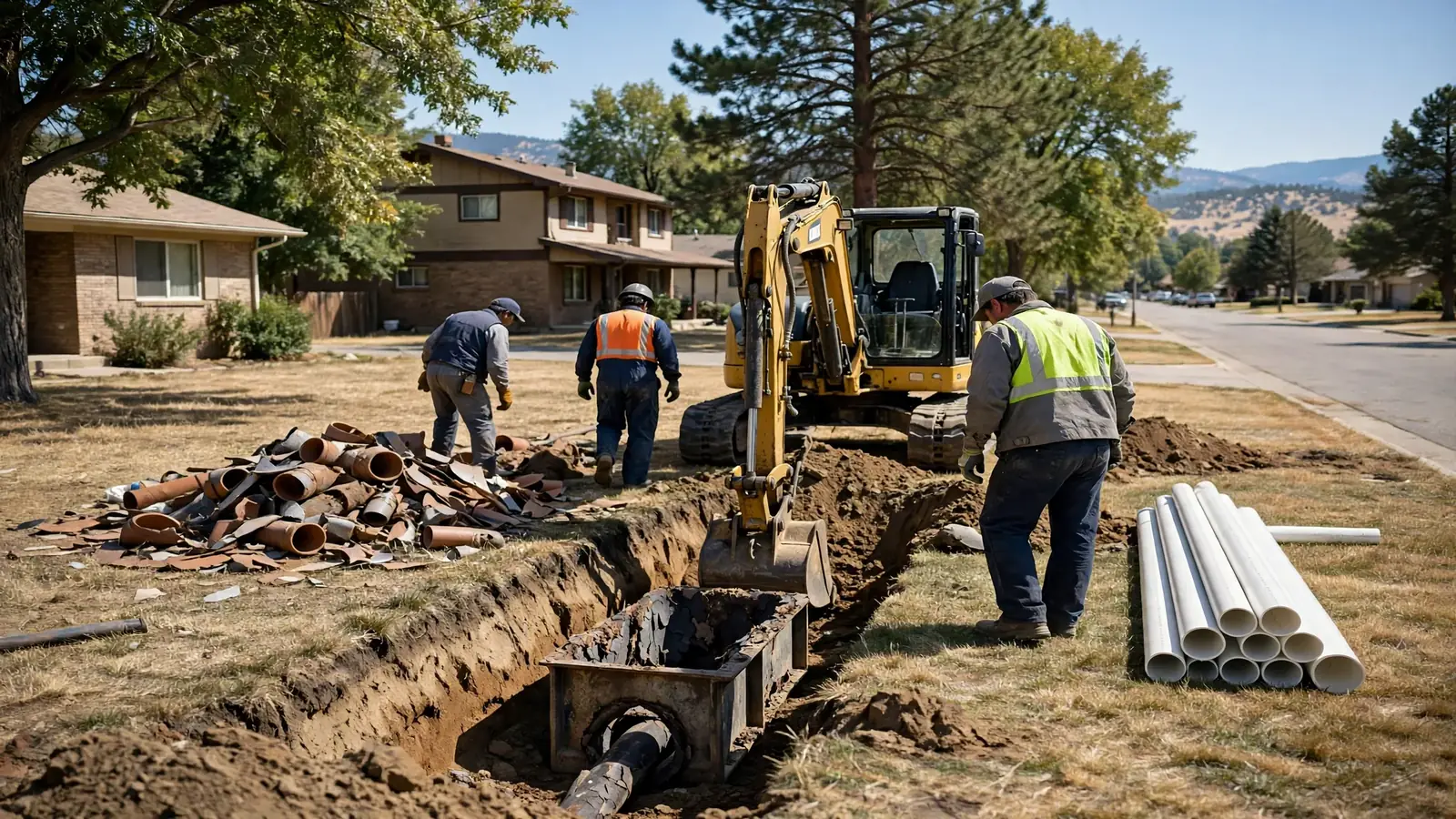
- Collapsed or crushed pipe. If the camera cannot pass, or the pipe has lost its round shape, it needs to come out.
- Orangeburg or badly corroded cast iron. Tar paper Orangeburg flattens with age. Cast iron scales and rusts from the inside until it splits.
- Repeat backups after cleaning. If the line clogs again within months, the pipe itself is the problem.
Two Ways We Replace a Sewer Line
Open trench replacement
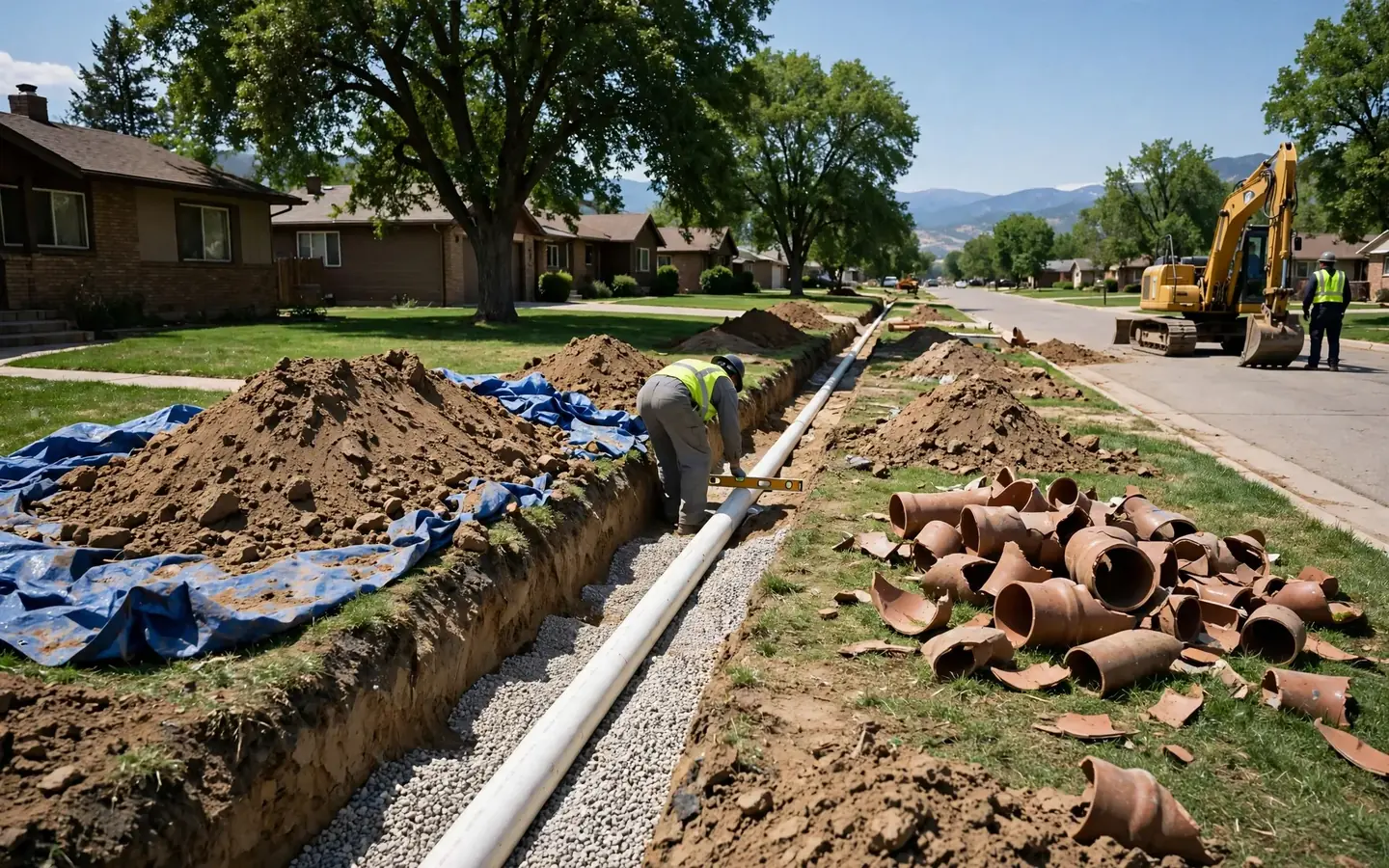
We dig along the path of the old pipe, remove it and lay new pipe on a graded bed so it keeps a steady downhill slope to the main. This is the right method when the line has a belly, needs a new route, or sits under open lawn with nothing in the way.
Pipe bursting
We dig one pit near the house and one near the connection. A bursting head pulls new pipe through the old path and breaks the old pipe apart into the soil. Your driveway, patio and mature trees stay in place. It works when the old line still runs at a usable slope.
What Goes Into the Ground
- PVC Schedule 40 or SDR 35 pipe for gravity sewer runs, joined so roots have no gap to enter.
- HDPE pipe for pipe bursting, fused into one continuous length.
- A two way cleanout near the foundation, so future cleaning can go toward the house or toward the street.
- Correct depth and slope. Littleton building code design criteria use a 36 inch frost depth, and gravity sewer needs a steady fall, usually about a quarter inch per foot.
Replacing the Part Under the Street
Many Littleton service lines continue under the sidewalk and into the street before they reach the main. Under Littleton City Code 7-5-24, that street section belongs to the homeowner too.
Work in the street adds two steps:
- A right of way permit. If your home is served by a district other than the City's and the work reaches City right of way, the City requires a separate right of way permit.
- A tap inspection. The connection at the district main is checked by the district. Columbine Water and Sanitation District, for example, inspects the tap connection and checks the contractor's licensing.
Will insurance pay for a new sewer line?
Usually not for age, wear or roots, which most standard homeowners policies exclude. A separate service line endorsement may cover it, so check your policy before work starts.
Ask your agent two questions: does my policy cover the private sewer lateral, and does it cover the section under the street?
Our Replacement Process, Start to Finish
- Camera scope and locate. We record the full run and mark depth at each problem spot.
- Plan the method. Trench or bursting, based on slope, depth and what sits above the pipe.
- Colorado 811 locate. State law requires the request before digging, and Colorado 811 asks for at least three business days of notice.
- District permit. Filed with the sanitation district that serves your address.
- Replace the pipe. Old line out or burst, new line in at the correct slope.
- New cleanout. Installed near the foundation for easy future access.
- Final scope and inspection. A video shows the new line clear from house to main, and the district inspects the connection.
Littleton Homes Most Likely to Need a New Line
- Historic Downtown (80120): some homes near Main Street date to the 1910s and 1950s, with clay or cast iron that has carried waste for generations.
- Columbine and Columbine West (80123, 80128): many 1960s and 1970s homes with clay pipe and mature trees between Clement Park and Chatfield State Park.
- Cherry Knolls (80121): larger lots, big trees and longer runs to the street.
Newer areas such as Highlands Ranch, built from 1981 on, mostly have PVC, so full replacement there is usually tied to a sag or a builder joint that separated.
Signs Replacement Is Due
- Orangeburg or badly scaled cast iron on camera: these materials cannot be reliably patched.
- Several breaks or offsets along the line: spot repairs would cost more than one new pipe.
- A collapse: the pipe has lost its shape.
- Repeat backups after repairs: the line has reached the end of its life; see how long sewer lines last.
What Affects the Cost
Every line is different, so a fair price comes after a camera scope, not before. These are the things that move the number up or down:
- Length of the line: from the house to the district main.
- Depth: deeper pipe means more digging.
- Method: open trench, pipe bursting or full lining.
- What is on top: driveways, trees, patios and landscaping to protect or restore.
- Work under the street: right of way permits, traffic control and street patching.
- Permits and inspection: city and district permits; see Littleton sewer permits.
Questions Littleton Homeowners Ask
How long does a full replacement take? A pipe bursting job is often finished in one or two days once permits are in hand. An open trench into the street can take longer.
Will you tear up my whole yard? Not with pipe bursting. With an open trench, we dig only along the pipe path and backfill when the new line passes inspection.
Can you replace only the yard section? Yes, if the camera shows the street section is sound. We scope the full run first so you only replace what has failed.
Do I need to leave my home? Usually no. You will need to limit water use while the line is disconnected.
Book a Camera Scope First
The camera tells us whether you need a full replacement, a partial run or just one repair. Call (888) 888 8888 and we will show you the video before you decide anything.